
What Is 3-3-3 Rule for Crane?
Crane lifting involves heavy loads, complex rigging, and changing operating conditions, so even a small mistake can create a serious safety risk. A Safe Load Indicator can help the operator understand the load being handled and whether the crane is operating within its rated limits. Along with proper planning, rigging inspection, and controlled crane movements, safety practices such as the 3-3-3 rule are often used as simple reminders during lifting operations.
What Is the 3-3-3 Rule for Crane?
The 3-3-3 rule for cranes is generally used as a simple safety guideline to help operators and lifting teams control a lifting operation. However, there is an important point to understand: there is not one universally accepted definition of the 3-3-3 rule across every crane operation or jurisdiction.
Different companies, training programs, and industry sources use the term in slightly different ways.
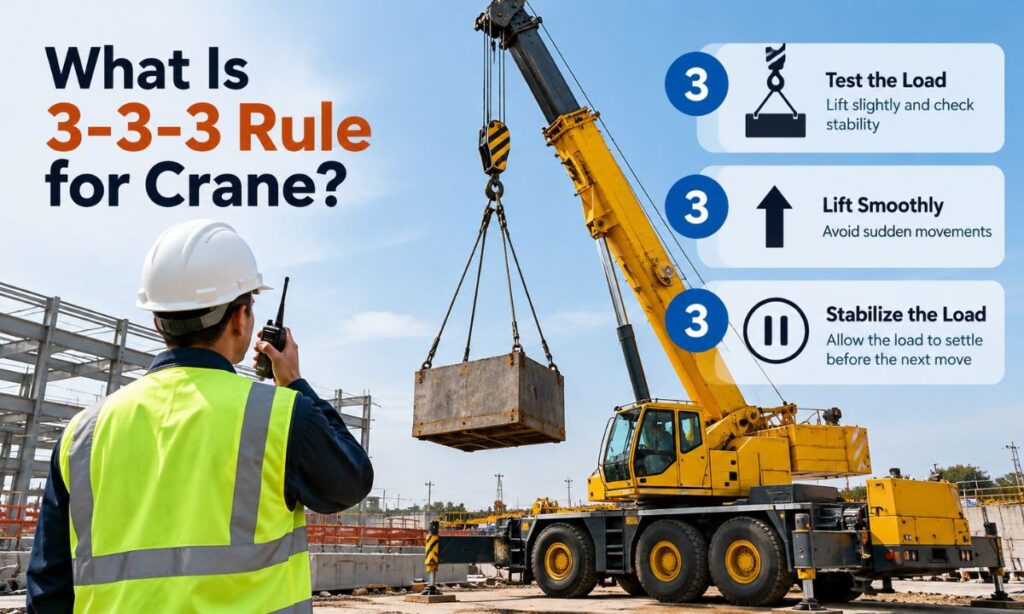
One commonly described approach uses three stages:
- 3 seconds for a test lift
- 3 seconds for smooth lifting
- 3 seconds for stabilization
The purpose is to avoid sudden movements, identify problems with the load or rigging early, and allow the load to settle before another crane movement is made. Some other sources use the term differently, so the site’s approved lifting procedure, manufacturer’s instructions, applicable regulations, and lift plan should always take priority.
How Does the 3-3-3 Rule Work?
The basic idea is to divide the lifting process into controlled stages rather than moving the load abruptly.
1. First 3: Test the Load
The first stage is a controlled test lift. The crane operator begins lifting the load only slightly from its resting position.
This allows the lifting team to check:
- Whether the load is balanced
- Whether the rigging is correctly positioned
- Whether slings or lifting accessories are behaving as expected
- Whether the load is beginning to shift
- Whether there are obstructions
- Whether the crane remains stable
A load should not simply be lifted quickly to full height without first confirming that the load and rigging are behaving correctly.
OSHA’s rules for crawler, locomotive, and truck cranes also require the crane to be level where necessary and the load to be properly secured and balanced before it is lifted more than a few inches.
2. Second 3: Lift Smoothly
Once the initial check is complete, the load can be raised in a controlled manner.
The operator should avoid:
- Sudden acceleration
- Sudden braking
- Jerking the load
- Excessive hoisting speed
- Unnecessary side loading
- Rapid changes in crane movement
Smooth operation helps reduce load swing and unnecessary shock loading.
The operator should also continue monitoring the crane’s operating conditions and the load throughout the lift. A crane must not be operated beyond its rated capacity.
3. Third 3: Allow the Load to Stabilise
After reaching the required lifting position, allowing the load to stabilise before beginning another movement can help reduce unwanted swinging.
Depending on the lifting operation, the next movement could involve:
- Slewing
- Luffing
- Trolley movement
- Positioning
- Lowering
- Placing the load
The important principle is to make sure the load is under control before introducing another movement.
Why Is the 3-3-3 Rule Important?
The main purpose of this approach is controlled lifting.
A crane does not simply lift a stationary weight vertically. The load, rigging, hook, wire rope, boom, and crane structure all interact during the operation.
A sudden movement can cause the load to swing or introduce additional forces into the lifting system.
Using a controlled sequence can help the lifting team identify problems earlier and reduce unnecessary movement.
However, the 3-3-3 rule should be treated as a practical safety guideline rather than a replacement for a proper lift plan, load chart, inspection, or manufacturer’s operating instructions.
What Should Be Checked Before a Crane Lift?
The 3-3-3 approach starts during the lifting process, but safe crane operation begins before the load leaves the ground.
A proper pre-lift check should consider:
Load Weight
The actual or properly established weight of the load should be known before lifting.
Crane Capacity
The crane’s rated capacity depends on factors such as configuration and operating radius. The applicable load chart should always be followed.
Rigging Equipment
Slings, shackles, hooks, lifting beams, and other accessories should be suitable for the intended lift and inspected as required.
Ground Conditions
For applicable crane operations, the crane should be positioned on suitable ground and properly supported according to the manufacturer’s requirements and the lift plan.
Load Radius
As the working radius changes, the crane’s lifting capacity can also change. Operators must use the appropriate load chart for the actual configuration.
Obstructions
The lifting path should be checked for structures, equipment, overhead hazards, personnel, and other potential obstructions.
Communication
The operator and lifting team should have an agreed communication method, particularly where the operator cannot clearly see the load.
What Is a Safe Load Indicator?

A Safe Load Indicator (SLI) is a crane safety and monitoring system that provides the operator with information about the crane’s load condition and operating limits.
Depending on the crane and system, an SLI may monitor parameters such as:
- Load
- Boom angle
- Working radius
- Crane configuration
- Rated capacity
- Percentage of capacity being used
- Overload conditions
The exact features vary between crane models and manufacturers.
An SLI can therefore provide valuable information to the operator during lifting, but it should not be considered a substitute for proper planning or operator judgment.
The applicable OSHA requirements also recognize load-indicating, weight-moment, and overload-protection devices in specified crane applications.
What Is a Load Moment Indicator?
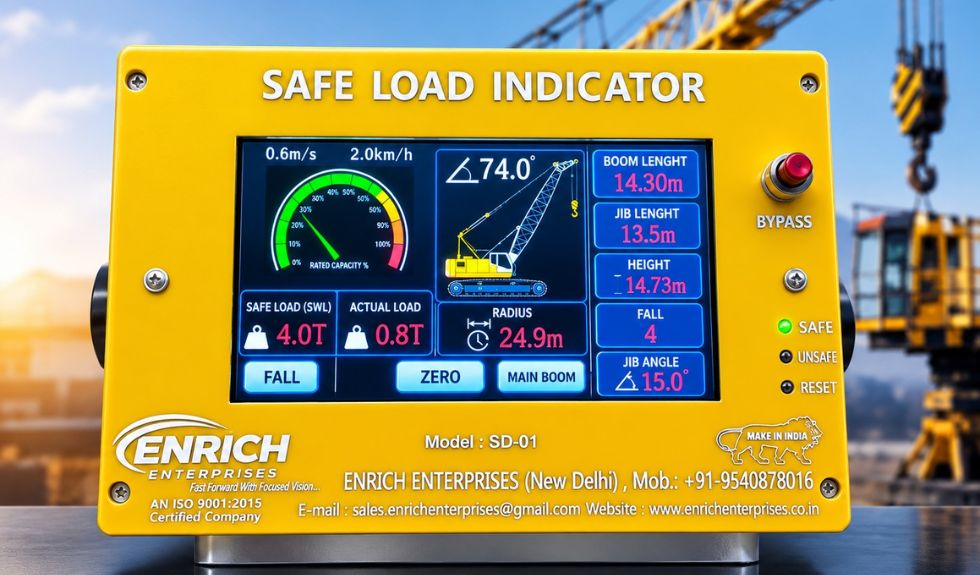
A Load Moment Indicator (LMI) is a system designed to help monitor the relationship between the load and the crane’s operating radius.
In simple terms:
Load Moment = Load × Radius
As the load or operating radius changes, the overturning moment affecting the crane can change as well.
An LMI can monitor this condition and provide information to the operator about how much of the crane’s rated capacity is being used. OSHA describes a load moment or rated-capacity indicator as a system that senses the overturning moment, compares the lifting condition with the equipment’s rated capacity, and indicates the percentage of capacity at which the equipment is working.
Some systems may also provide warnings when an overload condition is approaching.
Safe Load Indicator vs. Load Moment Indicator
Although the terms are sometimes used interchangeably in the industry, they can refer to different functions depending on the crane and manufacturer.
| Feature | Safe Load Indicator | Load Moment Indicator |
|---|---|---|
| Main purpose | Helps monitor safe crane operating conditions | Monitors load moment/rated capacity |
| Load information | May display or calculate load | Uses load and radius-related information |
| Radius monitoring | May be included | Commonly important to the calculation |
| Capacity information | Can show operating limits | Compares operating condition with rated capacity |
| Warning function | May provide overload warnings | May provide capacity/overload warnings |
| System features | Vary by manufacturer | Vary by manufacturer |
The exact terminology and functions should always be confirmed from the crane manufacturer’s documentation.
Is the 3-3-3 Rule an OSHA Requirement?
This is one of the most important questions when discussing the 3-3-3 rule.
The phrase “3-3-3 rule” should not automatically be presented as a specific OSHA regulation.
Industry sources describe the rule in different ways, which itself shows that the terminology is not universally standardized. For example, one source describes it as three seconds of test lifting, three seconds of smooth lifting, and three seconds of stabilization.
OSHA requirements instead address specific crane safety matters such as rated loads, inspections, stability, load-indicating devices in applicable operations, and safe operation.
For example, OSHA states that rated loads must not be exceeded in the applicable standard, and its crane rules address load-indicating and weight-moment devices in specified circumstances.
Therefore, operators should follow:
- Applicable regulations
- The crane manufacturer’s instructions
- The approved lift plan
- Site-specific safety procedures
- Qualified-person and signal-person requirements where applicable
The 3-3-3 approach can be used as an additional operational safety reminder where it is part of the site’s procedure.
Common Mistakes to Avoid During a 3-3-3 Lift
Even a simple safety guideline can become ineffective if it is treated as a shortcut.
Ignoring the Load Chart
Never assume that the crane can safely lift a load simply because the load appears to be below the crane’s maximum capacity.
The actual operating radius, configuration, boom length, attachments, and other conditions can affect capacity.
Skipping the Test Lift
A test lift can reveal problems with balance or rigging before the load is raised further.
Relying Only on the SLI or LMI
Electronic safety systems are useful aids, but they do not replace proper planning, inspection, and safe operating procedures.
Making Sudden Movements
Rapid acceleration, braking, slewing, or other abrupt movements can cause unwanted load swing and dynamic effects.
Continuing After an Unsafe Condition Appears
If the load shifts unexpectedly, rigging behaves abnormally, an obstruction appears, or another unsafe condition develops, the operation should be stopped and reassessed according to the applicable procedure.
3-3-3 Rule Crane Safety Checklist
Before and during a lift, the following quick checklist can help:
Load weight is known
Correct load chart is available
Crane configuration has been confirmed
Ground/support conditions have been checked
Rigging has been inspected
Load is properly secured
Lifting path is clear
Personnel are positioned safely
Communication method is established
SLI/LMI or other required safety devices are functioning
Test lift is performed according to the approved procedure
Load is stable before the next crane movement
Crane capacity is not exceeded
Final Thoughts
The 3-3-3 rule for cranes is best understood as a simple way of encouraging controlled lifting rather than as a universal crane regulation. One commonly described version uses three stages: a short test lift, controlled hoisting, and a stabilization period. However, the exact meaning can vary between organizations and lifting procedures.
The most important part of crane safety is not memorizing “3-3-3.” It is understanding the complete lifting operation—from load weight and crane capacity to rigging, radius, ground conditions, communication, and safe movement.
Equipment such as a Safe Load Indicator or Load Moment Indicator can provide important information to the crane operator, but these systems work as part of a broader safety process. Always follow the crane manufacturer’s instructions, applicable regulations, and the approved lifting procedure for the specific operation.